Off the Grid on Purpose: Why Downtown's Best-Kept Spots Are Refusing to Be Found
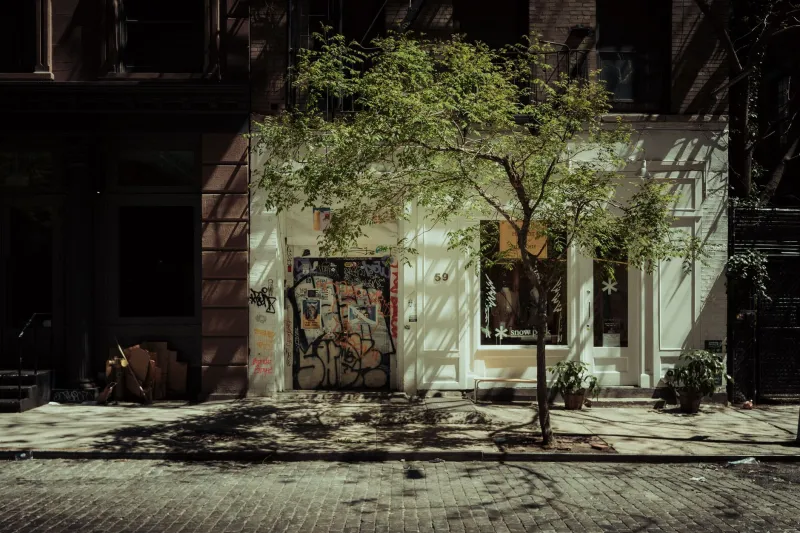
There's a ceramics studio somewhere below Delancey that's been operating for six years. No website. No Google Maps pin. No tagged location on Instagram. The people who go there found out through a friend, or a flyer stapled to a telephone pole that disintegrated in the rain two winters ago. The owner — who asked not to be named, which feels on-brand — said she had a listing once, briefly, in 2019. Within three weeks, she had a waitlist of strangers, two journalists asking for "access," and a landlord who suddenly remembered her lease was up for renegotiation.
She took the listing down. Problem solved.
This is not a rare story downtown anymore. Across the Lower East Side, Chinatown, Two Bridges, and into the edges of the East Village, a loose but deliberate movement has taken hold: spaces, businesses, and cultural venues that are choosing to stay invisible — not because they're struggling, but because invisibility is the only thing keeping them alive.
What Discovery Actually Costs
The logic of the internet age has always been that visibility equals opportunity. Get found, get customers, get revenue, survive. For a long time, that math held. But downtown NYC has become a case study in what happens when the math breaks.
A coffee shop gets tagged in a reel. By the weekend, there's a line around the block. By the following month, the rent is up for review. By the year after that, the coffee shop is gone — replaced, sometimes literally, by a concept that exists entirely to be photographed. The original community the place served has already moved on, because the place they knew no longer exists.
This cycle is so well-documented at this point that it barely registers as news. What's newer, and more interesting, is the counter-response: the deliberate, principled refusal to participate in the discovery economy at all.
"I don't want to be found by everyone," said one gallery operator who runs an invite-only exhibition space out of a building on the Bowery. "I want to be found by the right people. There's a difference, and the internet can't make that distinction for you."
The Mechanics of Staying Hidden
For spaces that have chosen this path, the practical logistics are surprisingly manageable — mostly because the tools for staying off the grid are the same tools that existed before the grid did.
Word of mouth is the obvious one, and it's still the most durable. A well-maintained network of trusted regulars who don't over-share is worth more than any algorithm. Several spaces operate through group chats — Signal threads, WhatsApp groups, old-school email lists — where information is shared selectively and the unspoken rule is that you don't post publicly.
Some spots go further. A natural wine bar in the lower reaches of Chinatown reportedly turns down press coverage as a matter of policy. A bookshop-slash-event-space near Essex Market hasn't updated its Google hours since it opened, leaving them perpetually listed as "temporarily closed." One long-running DIY venue doesn't have a name, at least not one that's publicly consistent — it cycles through different monikers depending on who's asking.
These aren't security measures against outsiders so much as they are friction mechanisms. A little inconvenience goes a long way toward filtering out the people who are just chasing content.
Authenticity as a Structural Defense
There's an irony embedded in all of this that's worth sitting with: in an era where "authenticity" has become one of the most aggressively marketed qualities a brand can claim, the spaces that are genuinely authentic are the ones going to lengths to avoid being marketed at all.
The boutique hotel down the street will tell you it's "rooted in the neighborhood." The ramen spot with the two-hour wait will describe itself as a "community gathering place." These are not lies, exactly — they're just performances of qualities that, in spaces choosing invisibility, exist as operational realities rather than branding copy.
When your regulars found you through a handwritten note at another spot they loved, the community isn't a talking point. It's the actual mechanism by which the place functions.
"There's no review on Yelp that's going to capture what happens here on a Tuesday night," said one event organizer who hosts monthly gatherings in a space that technically presents itself as a private members' club, though the membership process is deliberately vague. "And I'd rather it stay that way. The second you can rate it, you've changed what it is."
What This Means for the Neighborhood
The implications extend beyond individual businesses making savvy survival choices. At a neighborhood scale, the presence of unmappable, un-Googleable spaces creates a kind of cultural substrate that can't be easily commodified or extracted.
Real estate developers and hospitality groups have gotten extraordinarily good at identifying emerging cultural scenes and moving in before the scene has fully formed — using the presence of artists, small venues, and independent businesses as proof of concept for luxury development. But that process depends on legibility. It depends on data. It depends on the scene being visible enough to be measured.
Spaces that refuse visibility are, in a meaningful sense, refusing to provide the raw material for their own displacement. It's a limited defense — it doesn't stop gentrification, and it doesn't protect anyone's lease — but it does complicate the extraction process in ways that matter at the margins.
The Limits of Hiding
None of this is a perfect solution, and the people running these spaces are clear-eyed about that. Invisibility is a strategy, not a guarantee. Word of mouth scales eventually. The right journalist with the right connections can still blow a spot's cover. And there's a class dimension here that's impossible to ignore — spaces that operate off the grid are often accessible only to people who already have access to the right networks, which tend to skew in predictable directions.
There's also the question of sustainability. Running a business without the customer acquisition tools that every other business uses is genuinely hard. Some of these spots survive because their founders have other income. Others are operating on the kind of thin margins that one bad month can erase. The invisibility that protects them from one kind of threat can leave them exposed to another.
But for now, in a downtown that has watched so many of its defining spaces get discovered, celebrated, and then quietly hollowed out, the choice to stay off the map feels less like a quirk and more like a coherent philosophy. The algorithm doesn't know your block. Some people are starting to think that's exactly the point.
If you know, you know. And if you don't — well, maybe ask around.